Shaun the Sheep among 21 names on 2026/27 storm list
The Met Office has revealed the 21 names that could be used for major storms affecting the UK, Ireland and the Netherlands during the 2026/27 season, including Shaun the Sheep.
The new storm-naming season began on Tuesday 1 September 2026 and runs until 31 August 2027. More than 40,000 suggestions were submitted to the Met Office by members of the public last year. The final list also recognises meteorological pioneers and personal stories.
The scheme has been used since 2015 to give forecasts and warnings a clear, consistent reference point when severe weather is expected.
“For more than a decade, storm naming has helped us communicate the risks from severe weather more effectively. A named storm provides a clear focus for forecasts and warnings, helping more people understand the potential impacts and take action to protect themselves, their families and their property.”
Holly Clements, the Met Office’s head of warnings and guidance, said this.
Stories behind the names
The first three names are Austen, Boelo and Chloe. Chloe was nominated more than 130 times, including by the mother of a five-year-old who is “fascinated by the weather” and can “create a storm by herself” when she is tired.
Finn was suggested for a two-year-old described by his family as “wild and a force to be reckoned with”. Ivy was nominated for a nine-month-old Labrador puppy known as “the absolute destructor”. Nicola honours a mother who has “weathered many a storm and only come out stronger”, while Theo was inspired by a cat that hid before thunderstorms.
Met Éireann, Ireland’s national meteorological service, is marking its 90th anniversary by including names linked to its history. Austen honours Austen Nagle, the first director of the Irish Meteorological Service, while Evelyn recognises Evelyn Murphy, the first woman meteorologist to present a forecast on RTÉ.
The Dutch service KNMI selected Boelo, a nearly extinct name from East Groningen that has been passed down through the nominator’s family. Its other choices include names connected with coastal research, personal tributes and Dutch heritage.
Shaun was selected by the public in a vote held through a collaboration between the Met Office and Aardman. The partnership is intended to explain storm naming and weather warnings to new audiences in an accessible way.
When are storms named?
Storms are named when they are expected to bring medium or high impacts across the UK, Ireland or the Netherlands. This would typically mean that an amber or red warning is expected at some stage, although significant impacts from rain or snow can also lead to a storm being named.
Storm naming is intended to raise awareness before severe weather arrives. After Storm Goretti in January 2026, 93% of people in the amber warning area said they were aware of the warnings, while 88% took action, such as staying at home, avoiding driving or shopping earlier.
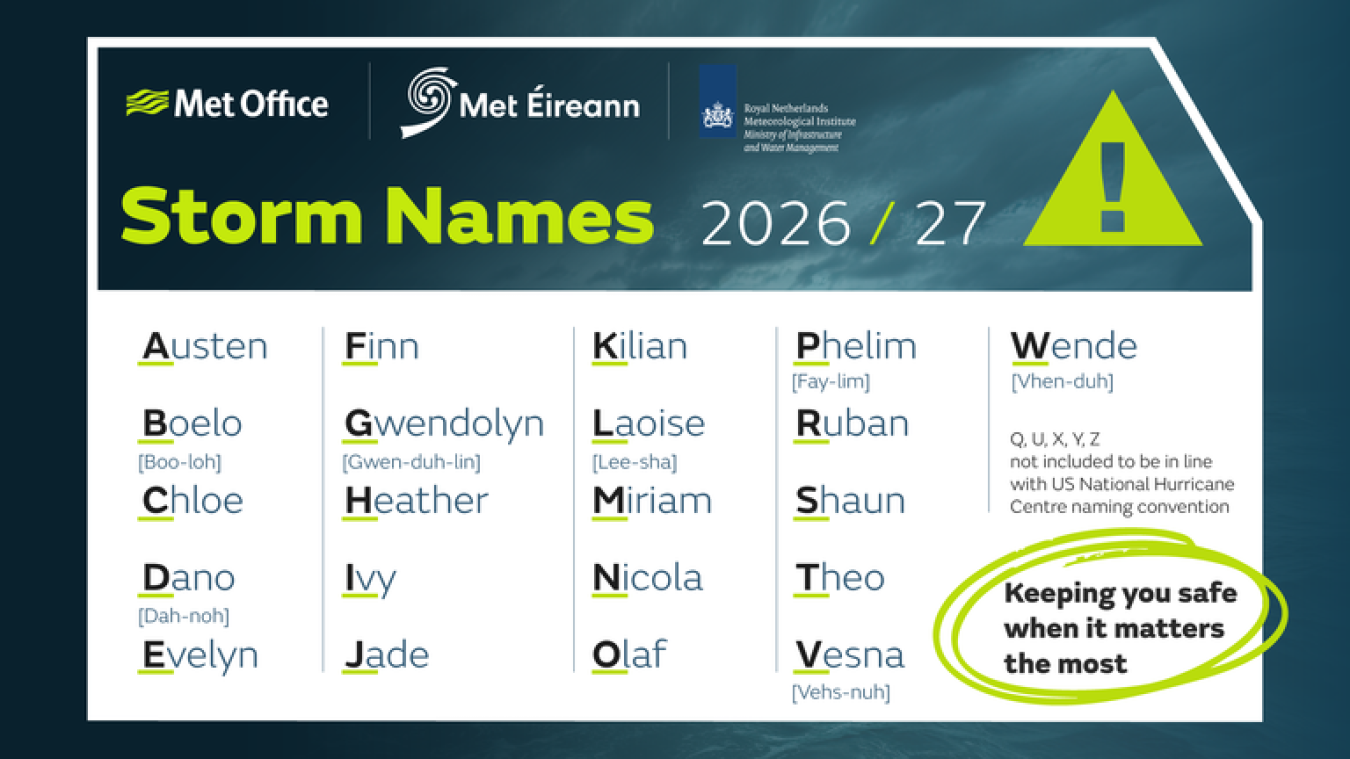
The 2026/27 storm names
- Austen – Met Éireann
- Boelo (Boo-loh) – KNMI
- Chloe – Met Office
- Dano (Dah-noh) – KNMI
- Evelyn – Met Éireann
- Finn – Met Office
- Gwendolyn (Gwen-duh-lin) – KNMI
- Heather – Met Éireann
- Ivy – Met Office
- Jade – KNMI
- Kilian – Met Éireann
- Laoise (Lee-sha) – Met Éireann
- Miriam – Met Éireann
- Nicola – Met Office
- Olaf – KNMI
- Phelim (Fay-lim) – Met Éireann
- Ruban – Met Office
- Shaun – Met Office
- Theo – Met Office
- Vesna (Vehs-nuh) – KNMI
- Wende (Vhen-duh) – KNMI
The list excludes Q, U, X, Y and Z in line with international storm-naming conventions. The three services consider pronunciation, different meanings across countries, links to public figures and whether a name could be controversial.
During the 2025/26 season, the Western Europe group named four storms, ending with Storm Dave in April 2026. The UK also experienced impacts from storms named by other European groups, including Benjamin, Claudia and Goretti. The record 2023/24 season showed how much the number of named storms can vary from year to year.
“We know that naming storms makes it easier for people to track important and up-to-date forecast and safety-related information as we can see from the levels of traffic and activity through our website and across social media platforms during storm events. 2026 marks the 90th anniversary of the establishment of the Irish Meteorological Service and we are proud to be able to recognise some of the significant contributors to our history in the list of storm names this year.”
Met Éireann’s head of forecasting division, Eoin Sherlock, said the new list would help keep severe-weather warnings easy to follow across the three countries.